When you look at the garbage in the trash can filled with empty plastic bottles, a special feeling of guilt arises. This begs the question: if the solution is in the kitchen, why do we still buy products that contain questionable ingredients and are packaged in disposable plastic?
The answer is not just about saving the planet. It has to do with what we put on our face.
We often operate on autopilot. We chose micellar water because of its speed. The tube works, so we skip it. But the accumulation of waste is real. What happens to those ingredients inside the tubes? They are not always very clean.
“Simple”Routine的隐性成本
让我们看看数字。 如果您每天化妆,每年可能会使用四到五瓶卸妆液。
五。
这听起来很小,除非你将其乘以数百万人。 这些瓶子大部分都是塑料的。 回收当然有帮助。 但仍有很大一部分最终进入垃圾填埋场或焚化炉。 通过改用可重复使用的玻璃瓶,您可以完全消除废物流。 你停止购买容器。 你停止购买填充物。
但还有一个比塑料更大的问题。 有化学负荷。
传统的清洁剂通常含有硫酸盐、合成防腐剂和人造香料。 这些不仅仅是为了让产品闻起来很香或者在货架上保存更长时间。 它们会破坏皮肤的天然水脂膜。 结果呢? 干燥。 刺激。 发红。
眼睛是脸上最娇嫩的部分。 他们首先做出反应。 如果您在清洁后感到刺痛或发红,则您的皮肤正在告诉您一些事情。
Why this DIY mix works
You don’t need a chemistry degree to make something effective. All you need is water and oil.
The secret to a good bi-phase cleanser is separation. The oil dissolves oil-based makeup (foundation, mascara, sunscreen). Water dissolves sweat and dust. Shake them together to create a temporary emulsion that removes everything without stripping your skin.
we are using blueberry flower water and jojoba oil for this recipe. This combination has proven to be effective both in traditional medicine and in modern dermatology.
Blueberry hydrosol: Soothing for Tired Eyes
Blueberry flower water, also known as “Centaurea cyanus” hydrosol, is not a new discovery. It has been used for centuries to treat eye irritation.
Why is it better than tap water?
Tap water is usually hard water, which means it contains a lot of calcium and minerals. These minerals can dry out the skin around the eyes. Blueberry hydrosol extracted by steam distillation, with a pH tailored to the sensitive skin around the eyes. Naturally, it has a decongestant effect.
If you wake up in the morning and your eyes are puffy, this is the solution. It calms inflammation. Reduces redness. It’s not just about clean. It’s treats.
荷荷巴油:不致粉刺的Powerhouse
你需要一种油来溶解你的化妆品。 但哪一个呢?
椰子油很重。 对于很多人来说,它会堵塞毛孔。 杏仁油虽好,但有些人会对它过敏。
荷荷巴油则不同。 从植物学上来说,它是一种液体蜡酯。 它的结构几乎与人类皮脂(皮肤自然产生的油脂)相同。 由于这种生物模仿,您的皮肤能够识别它。 它吸收后不会留下油腻的残留物。
它不会引起粉刺。 它不会堵塞你的毛孔。 它调节皮脂产生。 它滋养。 它能有效去除睫毛上的色素和长效睫毛膏。
如何制作您自己的双相洁面乳
过程很Simple。 首先对玻璃瓶进行消毒。 将其煮沸或用洗碗机清洗。 你想要一个干净的石板。
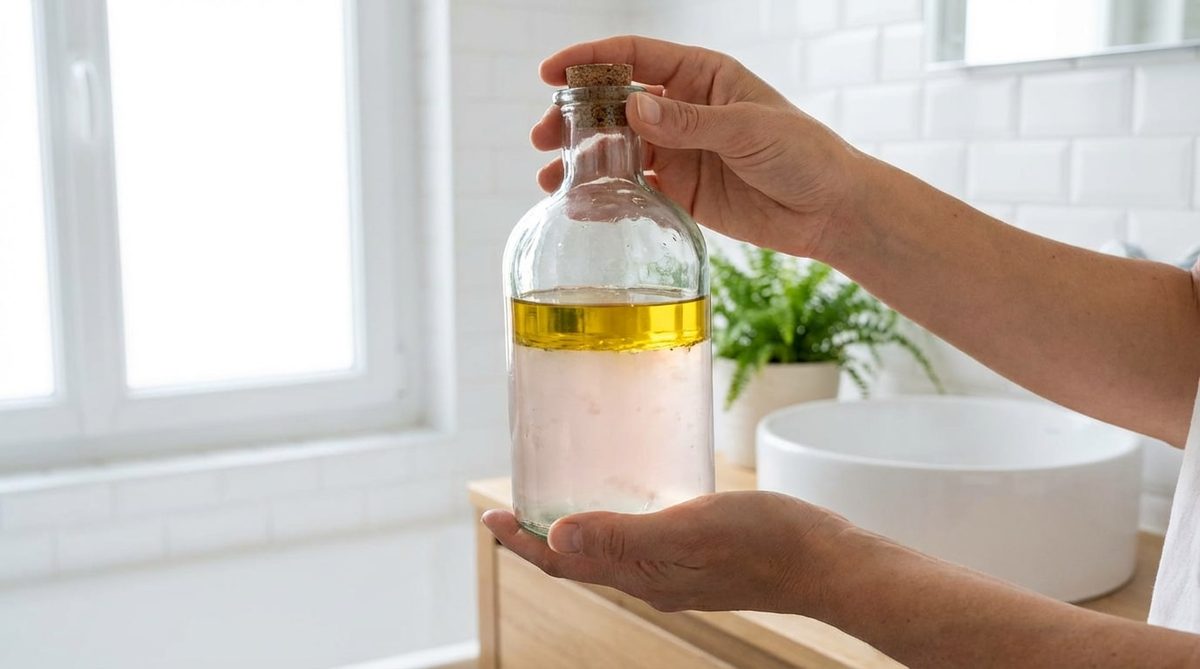
- 将蓝莓花水装满瓶子的三分之二 。
- 用荷荷巴油填充剩余的三分之一 。
- 每次使用前摇匀 。 相将再次分离,这是正常的。 只需充分摇匀即可混合使用。
涂抹在化妆棉上。 闭上眼睛轻轻按压几秒钟以溶解化妆品。 擦掉。 没有摩擦。 没有拉扯。
Is it worth it?
Making your own clean product requires a change in mindset. The materials must be purchased separately. You have to mix them together. You have to believe that less is more.
But consider the alternatives. You pay for packaging. You pay for marketing. You pay for preservatives keep the product stable, but can irritate the skin.
This do-it-yourself approach gives you control over your composition. You know exactly what is touching your face. There are two ingredients. Pure. Effective.
Pures without be stripped. Sometimes you just have to respect it.
The bottle is on the counter. Empty. Waiting to be filled. Instead of using another liquid with chemicals from a multinational company, use your own liquid. Something simple.
This is a small change. But this is a start.
There is a quiet rebellion in using a recycled bottle. You don’t need a lab coat, a precision scale, or a thermometer to make skincare that actually works. This is cold-blending for the rest of us. It is simple. It is accessible. And it turns what you already have into something useful.
The math of less is more: 2:1 ratio
Forget overcomplicating the chemistry. The texture of your makeup remover hinges on one specific ratio: two parts floral water to one part oil.
For this specific mix, you are using cornflower hydrosol and jojoba oil. Why this split? If you go too heavy on the oil, your eyelids will feel like they are coated in grease. If you use too much water, it won’t lift the gunk. The two-thirds water base keeps it light and fresh on the delicate eye area. The one-third jojoba oil is the workhorse—it dissolves makeup without turning your face into a slippery slide. It also protects the oil itself, which is the more precious ingredient here.
Shake before you use (always)
Water and oil are natural enemies. If you leave the bottle sitting on your vanity, you will see two distinct layers. The jojoba, being lighter, will float on top of the cornflower water.
This isn’t a defect. It’s a feature.
You have to shake the bottle hard before every single use. The goal is to create a temporary emulsion. You want a cloudy, milk-like liquid that distributes the oil droplets evenly throughout the water. Pour that mixture onto a washable cloth or a cotton pad while it’s still mixed. That brief moment of homogeneity is what allows the oil to grab the makeup while the water keeps it from feeling heavy.
Does it actually remove waterproof mascara?
Skepticism is healthy. We are used to industrial formulas loaded with solvents that seem indestructible. But basic chemistry holds up here: like dissolves like.
Makeup—whether it’s a everyday tint or stubborn waterproof liner—is made of oils, waxes, and pigments. Jojoba oil acts as a magnet for those components. It breaks down the structure of the makeup so it lifts away cleanly.
No more tugging
Most women know the feeling: rubbing your eye with aggressive force to get rid of that last speck of mascara. It’s painful. It damages lashes. It accelerates wrinkles.
This DIY solution changes the physics of removal. Because the oil is doing the work, the cotton pad glides. You don’t scrub. You press.
Hold the soaked pad against your closed eyelid for a few seconds. Let the oil penetrate and dissolve the product. Then, swipe gently outward. Friction is eliminated. Your skin stays intact.
The result: clean, not stripped
After you’re done, your skin shouldn’t feel tight or “squeaky clean” like it has after using a harsh soap. That tightness is your moisture barrier screaming for help. With this mix, your skin remains supple. The jojoba leaves a protective, breathable film that some people find so nourishing they skip their night cream entirely. For others, it preps the skin so well that the subsequent moisturizer sinks in faster.
The catch: shelf life matters
Homemade skincare comes with a new responsibility: preservation. Commercial products have preservatives that keep bacteria at bay for months in a steamy bathroom. You are making this without a safety net. You are dealing with live, organic ingredients.
The fridge is your best friend
Cornflower hydrosol is water-based. Without preservatives, it is a breeding ground for bacteria if left warm. Heat and light are the enemies here.
Store the bottle in the refrigerator. This does two things:
1. It stops microbial growth.
2. It makes the product colder.
Applying cold cornflower water to the eyes constricts blood vessels. It de-puffs. It wakes you up. It’s a bonus feature that costs nothing but a little fridge space.
Three weeks max
Do not make a gallon of this. Make what you will use in three weeks.
A 50ml or 100ml bottle is the sweet spot. If you make more, it will go bad before you use it up. If the smell changes, or if the liquid looks murky or separated in a way that shaking doesn’t fix, toss it. Clean the bottle with boiling water and start over.
Freshness is part of the efficacy. If you compromise on that, you’re not making skincare—you’re making a petri dish. Keep it small. Keep it cold. Keep it simple.
无塑料的回报
那种让事情变得更简单的直觉? 数字支持了这一点。 听起来很小。 混合你自己的东西感觉就像是一个微不足道的习惯改变。 但连锁反应是真实存在的。 有形。
首先,看垃圾。
通过改用这种极简主义的做法,您每年不再购买四五个塑料瓶。 就这样。 减少浪费。 不再有微小的一次性容器最终被扔进垃圾填埋场。 您购买原材料——油和花水——装在大玻璃罐或散装箱中。 包装与产品的比例急剧下降。
然后是混合瓶本身。
永远重复使用它。 最初的塑料足迹几乎立即得到回报。 几个月后? 基本上是免费的,可以继续使用。
Why DIY wins over pharmacy shelves
Let’s talk about money.
At first it felt like an investment. The cost of acquiring high quality bio-certified essential oils and hydrosols is not cheap. What you are buying is a concentrated form of the active ingredient. But only a few use each.
The calculation is easy. Per liter, the homemade formula costs two or three times less than the bi-phase remover from major pharmacies. That’s the price.
The quality gap is growing even more.
Pharmacy brands are diluting their formulas. Stabilizers, emulsifiers and preservatives are added. What is your combination? It’s clean. The concentration of active substances is higher. Does not contain synthetic fillers.
We never sacrifice quality for savings. You’re upgrading.
It makes sense to choose the simplest and most effective recipe without plastic bottles. Environmentally friendly. economically. Get better results with less money and less waste.
Is it worth the extra 5 minutes to prepare?
The data says yes.